Water Workforce Toolbox


Empowering Our People

PFAS Sampling

Keeping our water people safe when PFAS sampling

qldwater has developed a practical PFAS Sampling Fact Sheet to support water service providers in safely meeting increased monitoring requirements following recent regulatory changes. With more frequent sampling now required across drinking water, wastewater, soils and biosolids, the risk of accidental contamination has become a key challenge. PFAS compounds are widespread in everyday products, meaning even minor exposure during sampling can compromise results, leading to costly re-testing, delays and additional regulatory scrutiny.

This fact sheet brings together key guidance to help reduce contamination risks while maintaining worker safety. It outlines best-practice approaches for managing sampling equipment, handling and storage, and highlights common sources of PFAS exposure such as personal care products, sunscreen and certain clothing materials that should be avoided before and during sampling where possible.

Importantly, the resource balances sampling integrity with workplace health and safety obligations under the Work Health and Safety Act 2011. It provides practical, risk-based control measures to help organisations protect workers while complying with PFAS sampling protocols, including guidance on PPE, UV exposure, insect protection, and training requirements.

Download the fact sheet to support safe, compliant and reliable PFAS sampling practices across your organisation.
Download the fact sheet here.

Model Code of Practice


Practical guidance to protect workers

In March 2026, Safe Work Australia published the model Code of Practice: Managing the risks of biological hazards at work, the first Code of its kind in the world.

Biological hazards such as viruses, bacteria, parasites and certain types of fungi (like mould) can be found in all industries and workplaces including the water sector. Exposure to biological hazards can result in injury, illness and disease.

The model Code provides practical guidance to assist employers with protecting workers and others from exposure to biological hazards in their workplace.

This Code on managing the risks of biological hazards at work is an approved code of practice under section 274 of the Work Health and Safety Act (the WHS Act). An approved code of practice provides practical guidance on how to achieve the standards of work health and safety required under the WHS Act and the Work Health and Safety Regulations (the WHS Regulations) and effective ways to identify and manage risk.

SWA Model Code of Practice

Biological Hazards

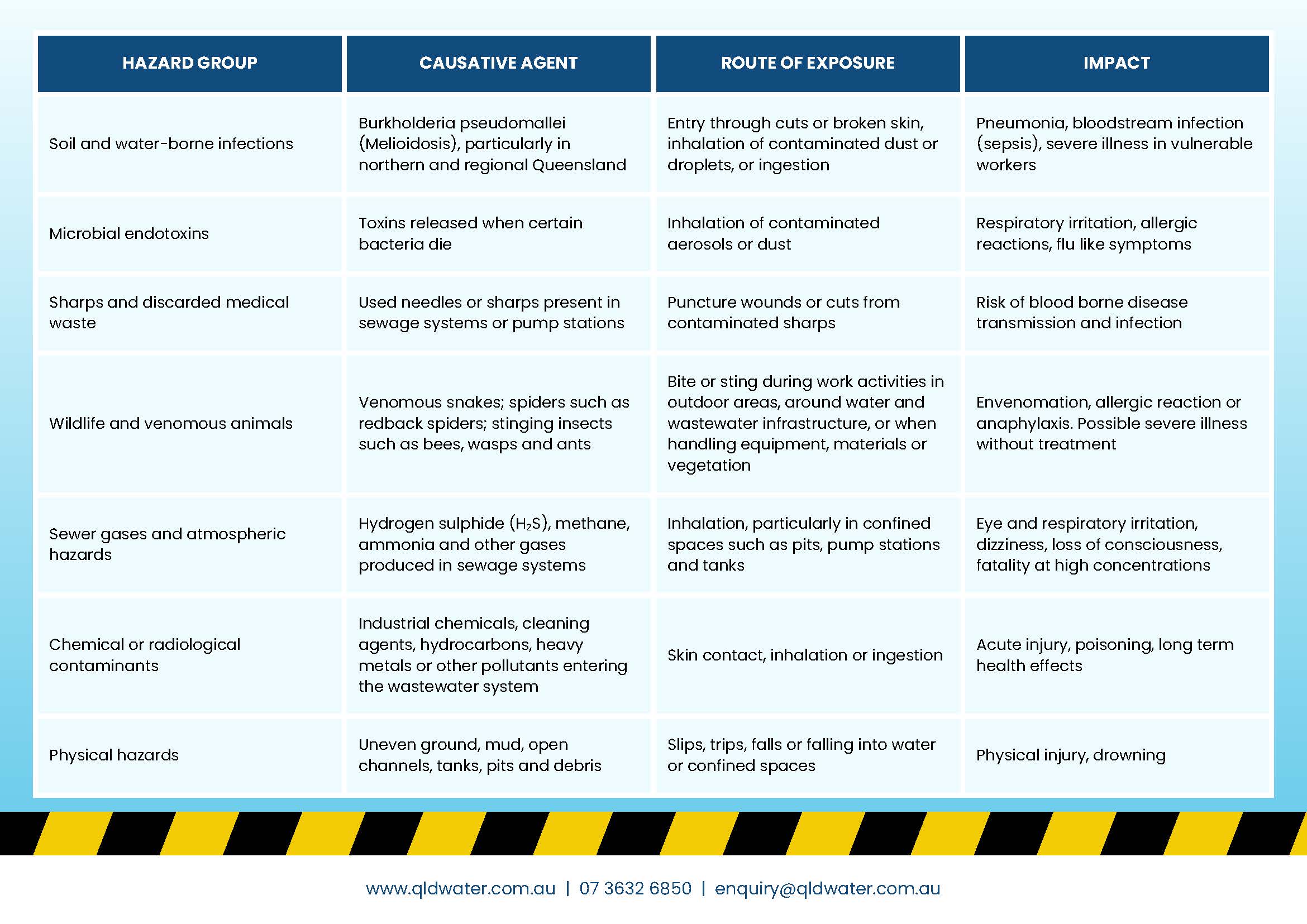
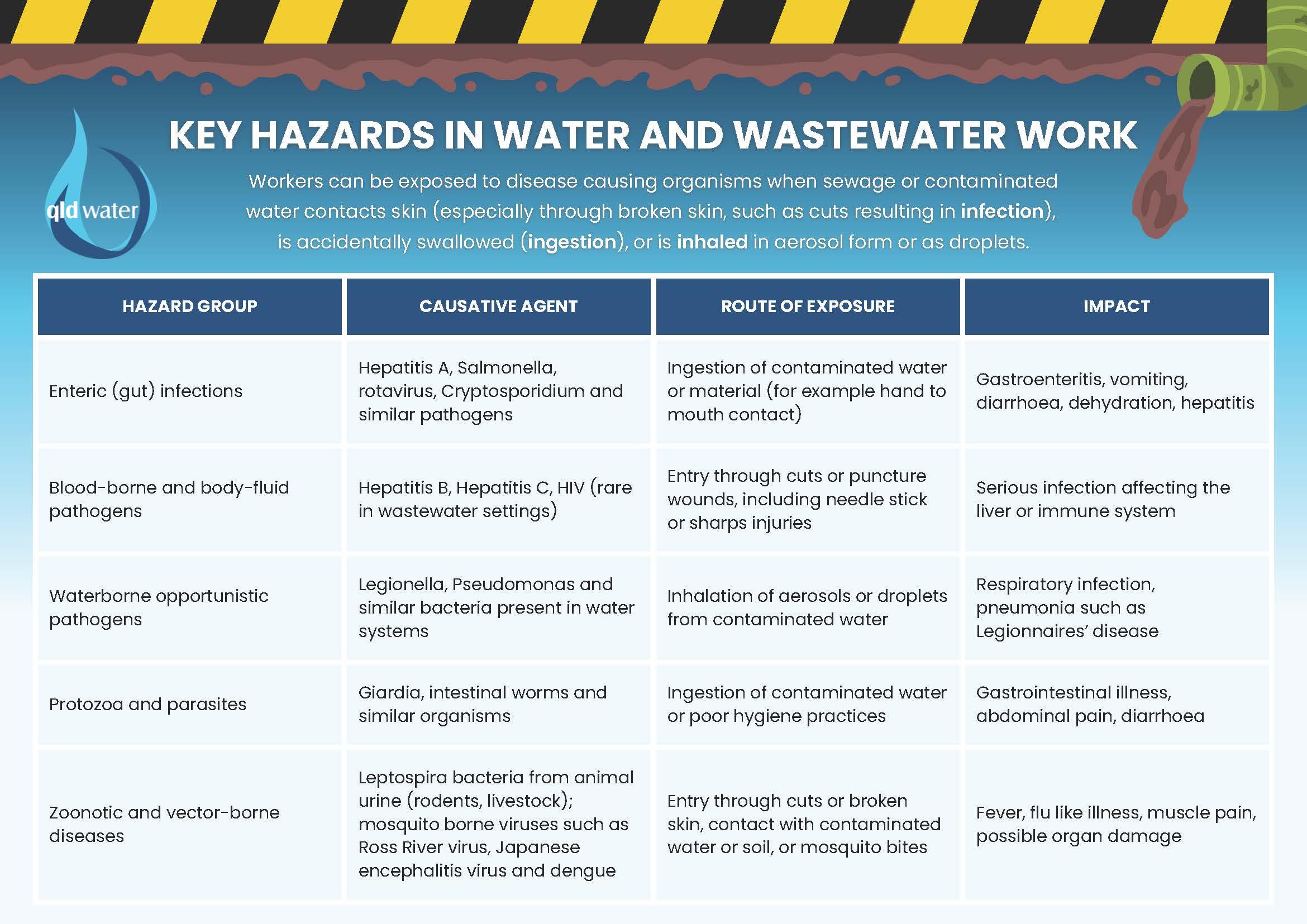
This fact sheet outlines the key biological hazards associated with water and wastewater work. Workers can be exposed to disease causing organisms when sewage or contaminated water contacts the skin (particularly through cuts or broken skin), is accidentally swallowed, or is inhaled as aerosols or droplets.

The document identifies common hazards, including the hazard group, causative agent, routes of exposure and potential health impacts, helping workers and managers understand risks and apply appropriate controls to prevent illness.

Key Hazards P1 Key Hazards P2

Download the Fact Sheet

WRF Guide for Utilities

Vaccination Hygiene Guidelines

The Vaccination Hygiene Guidelines prepared by qldwater provide a practical framework to prevent illness from biological hazards associated with working in water, recycled water, stormwater, sewage and biosolids in Queensland. The guideline sets out vaccination and hygiene controls to reduce exposure risks and supports employer and worker obligations under the Work Health and Safety Act 2011 (Qld).

It applies to all workers who may come into contact with untreated sewage, wastewater, recycled water, stormwater or biosolids, including field staff, operators, maintenance personnel, contractors and supervisors across water and wastewater operations.

The guideline outlines clear responsibilities for workers, supervisors and executives, covering hygiene practices, personal protective equipment (PPE), vaccination programs, training, incident reporting and organisational due diligence. Together, these measures help create safer workplaces and protect the health of workers exposed to biological hazards.

A template is available for qldwater members to modify - download the Word version below.

Download the template here.

Wellness Webinars for Water Professionals

The urban water sector is facing challenges around increasing workload pressures, extreme weather events and and organisational restructures, placing pressure on water sector workers.

In 2024/25, qldwater hosted a series of webinars delivered by leadership coach and water industry veteran Belinda Chapman.

Recordings of the webinars are available below:

Webinar 1: Building personal resilience to avoid burnout

Thursday 27 November 2024

In this webinar, Belinda provided some great tools including “name it to tame it” in acknowledgement of our feelings. She reflected on barriers like psychosocial hazards, job demands, conflict, poor organisational management, lack of role clarity and inadequate recognition to personal resilience. The presentation also included more information on burnout, the different degrees of burn and how to use self-leadership to cope with stress.

Webinar 2: Self-awareness for stress management and personal resilience

Thursday 19 June 2025

In this engaging and insightful webinar, Belinda explores the transformative power of self-awareness in managing stress and building personal resilience. Tailored for professionals in the water sector, the session offers practical tools and reflection techniques to help participants identify emotional triggers, enhance emotional clarity, and navigate daily pressures with confidence.

Download the presentation

Webinar 3: Self-regulation for coping with stress and building resilience

Thursday 18 September 2025

In this webinar, Belinda explains the power of the mind-body connection and provides techniques for self-regulation including the circle of control and influence; increasing your emotional vocabulary; and mimicking nature by pulsing throughout the day. She also explores in the moment techniques like a 6 second mindfulness pause, breathing exercises and the ability to manage thoughts through segmentation, reframing and perspective.

Download the presentation