Ready for Floods
Date: 03-Jun-2026
What does it really take to prepare for, respond to, and recover from a major flood event? That’s the question at the heart of a new game-based learning initiative developed for the Australian water sector, led by qldwater Communications Manager Des Gralton.
The game is an initiative of the AWA Water Literacy and Education and the Regional, Rural and Remote Water Specialist Networks, who led the adaptation of the internationally recognised Extreme Event game, with its first live Australian gameplay delivered at Ozwater’26 in Brisbane.
Originally developed by the US National Academy of Sciences, Extreme Eventhas been used around the world to help communities understand disaster resilience. For its Australian debut, the game was reimagined using local flood scenarios, drawing on the many real-world events experienced across the country with more than 20 flood or storm-related incidents since 2025 alone.
The use of gamification is intentional. Flood events are complex, involving everything from weather systems and catchment behaviour to infrastructure, planning decisions and community response. Games provide a powerful way to bring these elements together, helping participants see the bigger picture, explore trade-offs, and understand how decisions in one area can affect outcomes elsewhere. Just as importantly, learning becomes more engaging and memorable when people can see themselves reflected in the scenarios.
The game unfolds across four phases: Prepare, Respond, Recover and Adapt.
In the Prepare phase, players take on roles across six sectors: Businesses, Community Groups, First Responders, Households, Local & State Government, and Federal Government. Each group is given a set of 24 resource cards and must decide which 12 to invest in, setting the foundation for how well they can respond when disaster strikes.
During the Respond phase, players work within communities to manage one of six flood scenarios, each focused on impacts to water and sewerage systems. Participants must make critical decisions using the resources they selected with the option to trade resources between communities, highlighting the importance of collaboration and flexibility under pressure.
In Recover, players reflect on their decisions and outcomes. While scores are tallied, the emphasis shifts away from “winning” to understanding how cooperation, resource-sharing, and relationships contribute to stronger, more resilient communities.
Finally, the Adapt phase connects the experience back to real-world action, encouraging participants to think about how the lessons learned can be applied in their own organisations and communities.
Students who played the game as part of the Education Hub at Ozwater were asked to complete exit tickets to gain their feedback, and we were pleased that it showed strong learning outcomes, high engagement with the game format, and clear ideas for practical flood readiness actions.
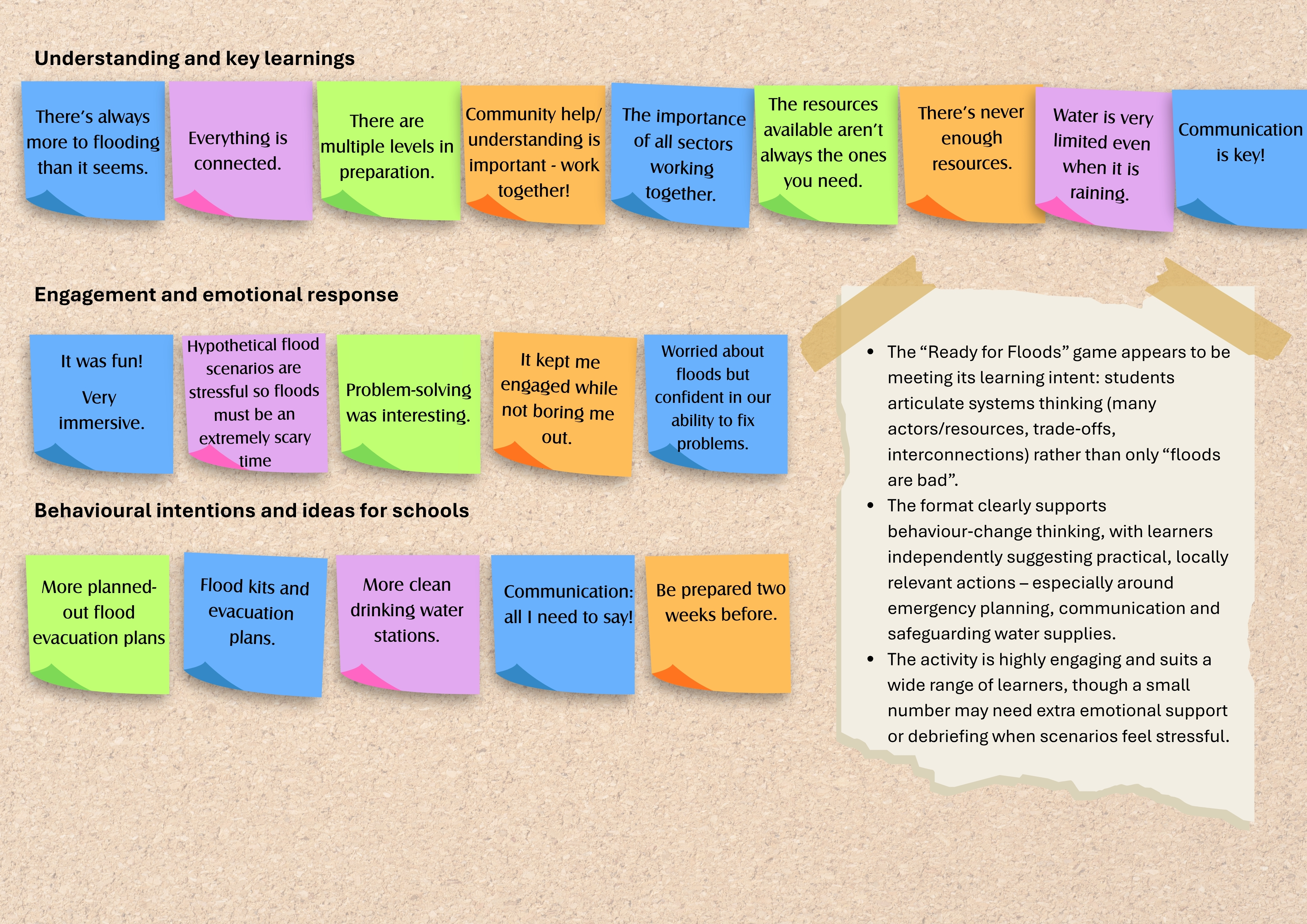
Following its successful debut at Ozwater’26, the game materials will soon be freely available through the AWA Water Literacy Specialist Network educational toolbox. This will allow organisations to tailor and apply the game as a workforce development tool, an emergency preparedness exercise, or a community engagement activity.
If gamification floats your boat, the ARC Training Centre for Climate-Resilient Water has a PhD opportunity available that may be of interest. The scope is to develop a gaming framework to educate government stakeholders on water security challenges, and improve non-technical stakeholders understand risks and trade-offs.
The framework would aim to improve policy support, communication, and stakeholder understanding through interactive scenarios. This could include incorporating challenges from demand management, exploring how interactive approaches could enhance engagement and effectiveness in promoting water efficiency and conservation. Contact Angela Dean for more information.
Back to list