eFlash #650
Date: 25-Mar-2026
In this edition: Fuel Concerns | Emerging Supply Issues for Plastic Pipes | Environment Forum 2026 Presentations | Disinfection by-products: A fresh look at an old problem | Nature-Based Solutions Bus Tour and Networking Drinks | Fire Ant Zoning Changes | AWA QLD Events | Drinking Water Regulation Workshop | WIOA QLD Conference | New IChEMS scheduling decisions for PFAS
Fuel Concerns
There's distinct concern from the urban water sector about whether the Federal Government fully understands the real time effect on the ground of the current fuel supply issues, particularly in our regional and remote areas. Often operating out of sight, the urban water sector can be (and has been) overlooked in times of crisis. However, it is primary to community safety and the effective and efficient operation of Australian businesses.
Fuel rationing in Australia is regulated at both the federal and state levels, primarily designed for severe, national liquid fuel emergencies. The core legislation governing this is the Liquid Fuel Emergency Act 1984 (Cth), which empowers the federal Minister for Energy to implement a national system of rationing to manage fuel shortages.
Queensland’s urban water sector provides a critical service that underpins public health, environmental protection, and the functioning of our communities and economy. Diesel in particular, also provides back-up power for essential water services and given that we are still in the high-risk weather season, keeping back-up generators fully fuelled is a priority. The sector also requires continuous deliveries of water treatment chemicals.
As such, qldwater has written to the relevant Ministers calling for:
- Immediate recognition of the sector as an essential service, with priority access to diesel and petrol – extending, but not limited to chemical delivery services;
- Inclusion in fuel allocation and emergency management frameworks;
- Identification and recognition of critical urban water personnel should fuel rationing occur [it is essential that these personnel can travel to site(s) to undertake essential water operational works];
- Consideration of fuel subsidies to remote and regional councils so that they can continue to deliver essential services;
- Ongoing engagement with Queensland’s urban water sector to monitor impacts and coordinate responses.
Emerging supply risks for plastic pipes used in water infrastructure
We have become aware that water utilities and councils may face emerging supply chain pressures for plastic pipes used in water mains, particularly PVC and polyethylene (PE/HDPE). The following has been assembled from sources provided to us by sector pipe suppliers.
Reportedly, recent supplier notices indicate significant price increases for plastic pipes taking effect from mid-April 2026, alongside reduced quote validity and potential surcharges.
Reported increases are substantial, with PVC products rising by around 27% and polyethylene by up to 36–40%. These changes are being driven by global factors rather than local demand, including disruptions to petrochemical supply chains, rising oil and feedstock costs, and freight volatility. Australia’s reliance on imported plastic resins amplifies exposure to these pressures.
For the urban water sector, the immediate risk is not widespread product shortages, but rapid cost escalation and procurement uncertainty. Utilities may experience budget impacts for capital works, reduced certainty in supplier quotes, and potential delays for large or non-standard pipe orders.
We encourage our members to engage with suppliers, confirm pricing conditions, and consider forward procurement for committed projects. This is a developing situation and should be monitored, particularly for polyethylene products, which appear most exposed to current market volatility.
Environment Forum 2026
Presentations and photos from the Environment Forum: Offsets and Outcomes – Delivering Environmental Value Through Water Services, held at Redlands IndigiScapes Centre, Capalaba on 26 February 2026, are now available on the qldwater website.
The Forum brought together practitioners, researchers and policy leaders to explore how water services can deliver stronger environmental outcomes through integrated, outcome focused approaches, highlighting offsets, credits, nature based solutions and emerging markets.
Disinfection by products: A fresh look at an old problem
Safe drinking water depends on effective disinfection, yet disinfectants such as chlorine can react with naturally occurring compounds in water to form disinfection by-products (DBPs), some of which are toxic.
Join us at 10am on Thursday, 16 April for a webinar exploring a research program being led by Professor Fred Leusch on whether common DBP mitigation strategies may unintentionally increase toxicity. By combining advanced chemical analysis with innovative bioassay testing, the project evaluates both DBP formation and their overall toxic effects. Working with Australian water utilities, the research identifies treatment approaches that minimise DBP toxicity while maintaining effective pathogen control. The outcomes will provide practical guidance to help utilities optimise treatment processes and support the continued delivery of safe drinking water to communities.
Nature-Based Solutions Bus Tour and Networking Drinks
Stormwater Queensland and the Queensland Water Directorate will be hosting a Nature-Based Solutions Bus Tour on Thursday 7 May 2026.
The tour will include site visits to the two most iconic offsets-related nature-based solutions projects completed in Queensland in 2026 including:
- The Urban Utilities Cannery Creek sewer upgrade project which included sediment basins, fish screens, a wet weather pump station, screening chamber, over two kilometres of new underground pipelines, riparian restoration, a constructed wetland and two bioretention basins.
- Redland Bay Regional Council’s Shoreline Mangrove Offset Project (SMOP) delivered in partnership with Stockland which includes the construction of the Southern Redland Bay Wastewater Treatment Plant and offsetting nutrient loads from this plant via a recently completed 9.8-hectare mangrove wetland. The system works with natural tidal flows supporting water quality, biodiversity, and long-term shoreline resilience. This part of the tour will focus on the mangrove wetland rather than the treatment plant.
Presentations will include discussions about community engagement, design, approvals, construction, operation, establishment, maintenance and monitoring.
These projects have direct relevance to stormwater and wastewater practitioners alike with directly transferrable approaches adopted by these projects to both water streams. They exemplify the practical application of Total Water Cycle Management principles and while they may be a first of their kind nationally, the lessons to be shared can be applied broadly to many different types of projects.
Places are strictly limited and expected to fill quickly.
OTHER NEWS
Fire Ant Zoning Changes
Fire ant biosecurity zones are in place across Queensland to prevent the spread of fire ants and to protect unaffected areas. There are 2 fire ant biosecurity zones. New suburbs may be added to the zones each month, while others may change zones.
Queensland’s fire ant biosecurity zones are reviewed and updated monthly to align with the Interstate Plant Quarantine (IPQ) zones. The changes will reflect the latest fire ant detections and will help reduce the risk of human-assisted spread of fire ants.
The shift from regular reviews of the fire ant biosecurity zones to monthly aligns with the Fire Ant Response Plan 2023–2027. These changes will:
- reduce confusion regarding intrastate and interstate movement restrictions
- provide a more targeted approach to fire ant management. The new fire ant biosecurity zones will extend 5 km beyond known fire ant detections, rather than the biosecurity zones following suburb boundaries
- reduce restrictions on residents and businesses who are not at risk of moving a fire ant as they are well beyond 5 km from an infestation. Using suburb boundaries was appropriate when the infestation was predominantly in urban areas with smaller suburbs, but with the infestation now in rural areas including much larger suburbs, there are mismatches between the boundaries of the IPQ and fire ant biosecurity zones
- allow a more rapid response to control the spread of fire ants as biosecurity zones will be updated monthly.
AWA QLD Events
The Australian Water Association has a few upcoming events worth noting:
Join the Australian Water Association QLD Branch at Boundary Hotel, West End for the Queensland Sundowner. Catch up with water sector colleagues over drinks, light bites and good conversation in a relaxed setting.
QLD Regional Tech Event – 21 July
Hosted by Gympie Regional Council, this event will feature a morning of technical presentations, and a panel Q&A followed by a local site tour.
Queensland Conference 2026 – 13 to 14 October
Under the theme “One Water, One Future: Uniting Queensland’s Water Story,” the 2026 Queensland Conference brings together utilities, government, Traditional Owners and industry to share ideas, strengthen partnerships and shape a resilient, sustainable water future.
Drinking Water Regulation Workshop
The Water Supply Regulation team is conducting a Drinking Water Regulation workshop in Cairns on Tuesday 21 April 2026.
The agenda includes presentations by Water Supply Regulation on a range of topics including commissioning of new infrastructure, water quality results and incident reporting. Queensland Health and service providers will also deliver presentations about operational challengers and relevant current issues.
WIOA QLD Conference
Companies servicing the Australian water industry operations sector are invited to partner with WIOA for the 2026 Queensland Water Industry Operations Conference & Exhibition on the Gold Coast and/or their associated events.
The Water Industry Operations Association [WIOA] offer a range of sponsorship opportunities designed for organisations looking to align their brand with their mission of supporting industry development and strengthening the connection between professionals in the field.
This is more than a branding exercise; it is an invitation to work together with WIOA in delivering an excellent experience for the operators and leaders who gather at these annual Queensland events.
By securing a premium exhibitor site or a tailored sponsorship package, your organisation will join WIOA in directly supporting the frontline of the water operations industry.
Explore the Partnership opportunities and book early to ensure you maximise your visibility across the sector: Sponsorship - WIOA
CURRENT CONSULTATIONS
New IChEMS scheduling decisions for PFAS
DCCEEW has a just opened a consultation on a raft of IChEMS scheduling decision for PFAS chemicals. It appears that this has been prompted by the recommendations from the PFAS Senate Select Committee report, published last November.
The scheduling decisions up for consultation are as follows:
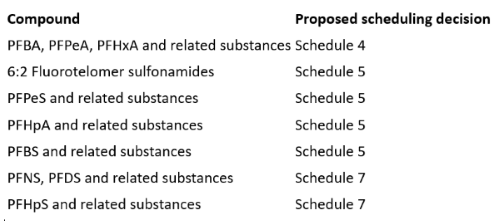
The proposed scheduling decisions apply a tiered risk management framework across the PFAS classes instead of a blanket Schedule 7 listing, which provides a prohibition on imports and use. Schedule 4 and 5 chemicals are subject to managed phase-down through transition requirements, use restrictions, and waste controls that are not as strong.
PFOS, PFOA and PFHxS were listed on Schedule 7 in July 2025, with bans on imports of chemicals and articles containing the listed chemicals, and restrictions on “unintentional contamination” of up to 25 µg/kg (25 ppb). The Schedule 7 listing of PFNS, PFDS and PFHpS proposes similar restrictions.
A handful of other chemicals of concern have also been listed.
The consultation will be open until 24 April. qldwater will be making a submission.
If you want to find out more, please visit the consultation page.
UPCOMING EVENTS
- 16 April - Essentials Webinar - Disinfection Byproducts: A fresh look at an old problem
- 7 May - Nature-Based Solutions Bus Tour
- 26-28 May - AWA Ozwater'26
- 23-24 June - WIOA QLD Conference & Exhibition